
Release sent on May 19, 2023
Participation involves the presentation of four articles that address planning, technology and socio-environmental issues in the implementation and operation of transmission lines
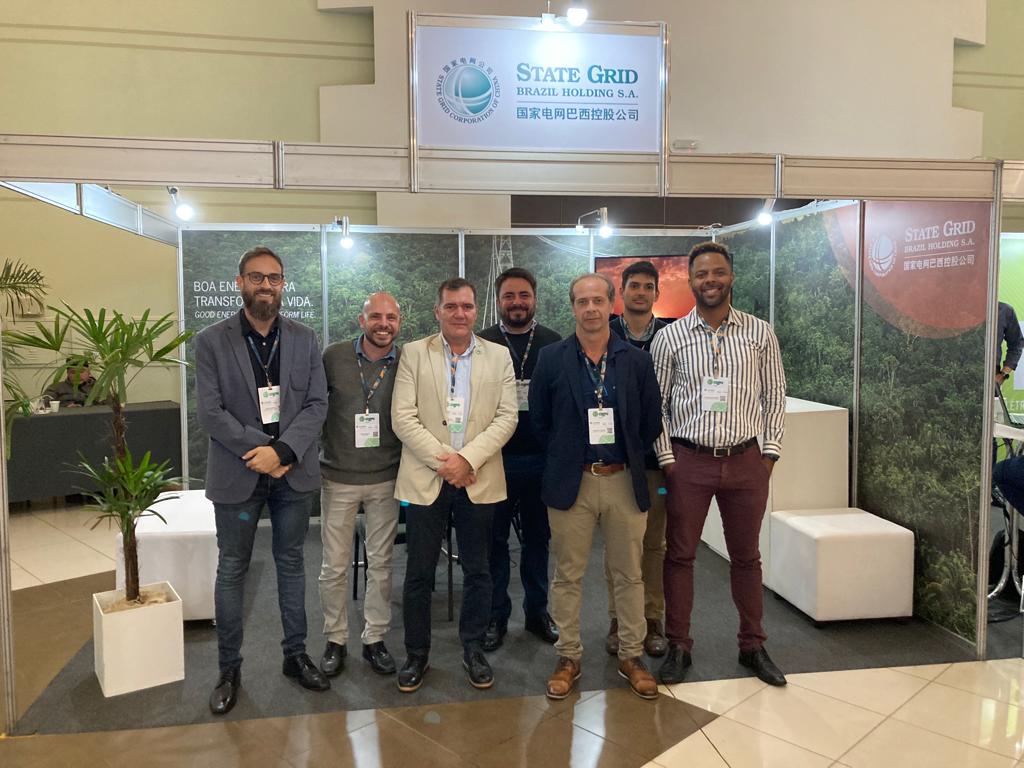
State Grid Brazil Holding (SGBH) will be participating in the XIX ERIAC – Ibero-American Regional Meeting of CIGRE-Brasil (Brazilian National Committee for Electric Energy Production and Transmission) from May 21 to 25, in Foz do Iguaçu (PR). Held every two years, ERIAC brings together professionals from the energy sector from Brazil, Argentina, Chile, Colombia, Paraguay, Peru, Mexico, Spain and Portugal.
Ramon Haddad, vice president of State Grid Brazil Holding, explains that ERIAC is a forum of great international technological excellence and that strategically SGBH always participates and marks its presence.
In this year's edition, in addition to being a sponsor of the event, SGBH contributed with the presentation of four technical papers. The articles “Optimization of the Legal Reserve Program with Social Communication” and “Minimization of environmental impacts in the construction of LTs in vereda areas” were written by the environmental engineer of Paranaíba Transmissora de Energia, Luíza Martins. Paranaíba is a joint-venture concessionaire in which State Grid Brazil Holding holds a 51% stake together with Copel (24.5%) and Furnas (24.5%).
Two other articles sponsored by SGBH – “Modeling of a stylized system for studies of HVDC Transmission System using VSC Converters and Overhead Line” and “Energization of MMC-HVDC system considering a proposal for pre-charging of sub-modules and use of circuit breaker with RPI” – will be presented in a plenary session by researchers from the Fluminense Federal University (UFF). Both are part of R&D projects of SGBH and the research project on VSC Converters for HVDC Transmission using Overhead Lines also had the participation of researchers from Nari Brasil Holding, Powerconsult Engenharia de Sistemas Elétricos and the Fluminense Federal University (UFF).
Jorge Bauer, Vice President of State Grid Brazil Holding, highlighted that “This is an important opportunity for the international exchange of best practices in the electricity sector. Participating in this event and sharing our experiences demonstrates that we are at the forefront, always with innovative practices and cutting-edge technology, both in the implementation of our projects and in the operation and maintenance of our transmission systems.”
The article “Optimization of the Legal Reserve Program with Social Communication” deals with the approach used in Legal Reserve areas on rural properties crossed by the Paranaíba Transmissora de Energia Transmission Lines. Faced with the challenge of dealing with many landowners involved, Paranaíba created a department to deal with the issue, jointly carrying out the Social Communication Program – through ombudsman forms with questions, criticisms and compliments on the activities carried out. The study attests to the results of the unified strategy and the Legal Reserve Regularization Program, considering that most landowners already have their properties regularized in the Rural Environmental Registry, assisted by the concessionaire.
In the study “Minimizing environmental impacts in the construction of transmission lines in veredas areas”, the focus is on the environmental procedures and engineering solutions adopted by Paranaíba in the passage of the Transmission Line in a specific area of veredas (considered Permanent Preservation Areas - APP) along the route. The 500kV Barreiras - Rio das Éguas - Luziânia - Pirapora transmission line extends for 953km, crossing 19 municipalities in the states of Bahia, Goiás and Minas Gerais, and the Bahia region has a large number of small veredas.
“For the implementation of the project in section G1 (Barreiras II / Rio das Éguas), in Bahia, the contracted company, in a specific case, decided to cross this area in particular, thus avoiding a detour of approximately 60 km along the length of the Line”, details Luíza Martins, whose study assesses the final cost of the measure adopted, recommending a cost-benefit analysis in similar cases.